Ergonomics in VR
Designing a VR training environment around human movement, task requirements and cognitive efficiency.
Applying human-factors research to make VR-based aircraft maintenance training safer, clearer and more cognitively efficient.
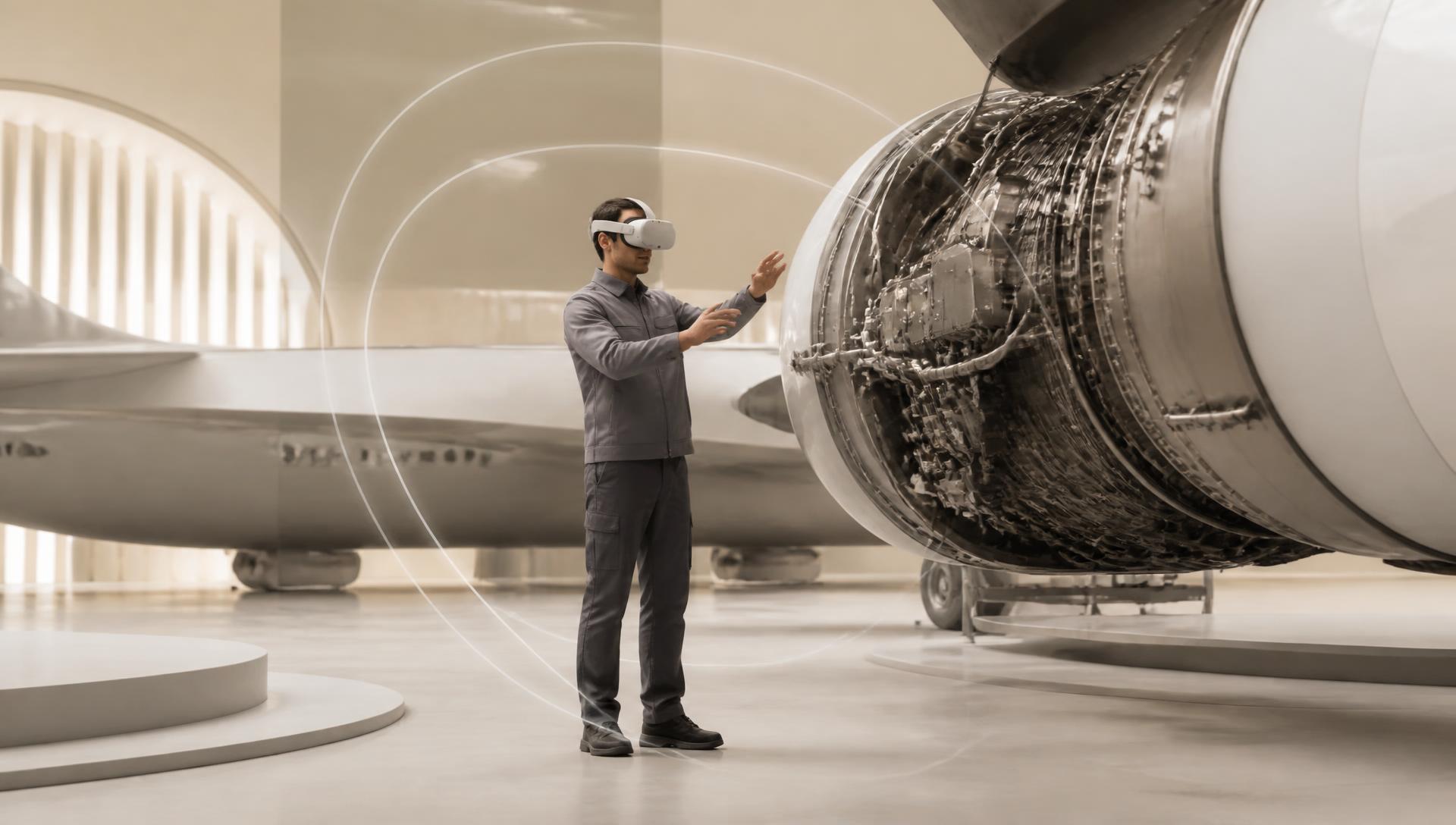
Pre-flight maintenance training can require expensive physical equipment and controlled environments. This project explored how VR could provide a safe, repeatable training space for aircraft engineers and students while applying human-factors research to the interaction and spatial design.
How Should a VR Training Environment Behave Around the Human?
The project focused on understanding how physical and cognitive factors influence interaction within a VR maintenance task.
- ▪Physical posture
- ▪Reachability
- ▪Interaction distance
- ▪Controller movement
- ▪Cognitive load
- ▪Workspace layout
- ▪VR interface placement
Designing for the Person, Not Just the Task
The relationship between human factors and VR interaction shaped every design decision.
From Maintenance Task to VR Interaction
The project translated pre-flight maintenance requirements into a VR training experience.
Building the Training Environment
The environment was structured to support reachability, movement, workspace awareness and interaction distance.
The virtual space was organised around the engineer's body, not the aircraft alone. Every placement decision considered how far the user could comfortably reach, where the gaze naturally rested, and how the workspace should be arranged to reduce strain during repeated tasks.
What the Research Informed
Four concise outcomes that emerged from the research and design process.
Considerations for physical posture, reachability and movement during repeated maintenance tasks.
Guidance for designing VR interactions around human behaviour and task requirements.
Recommendations for organising the virtual maintenance workspace to support awareness and reduce strain.
A VR prototype exploring a safer and repeatable approach to pre-flight maintenance practice.
Research in Practice
The VR prototype translated research considerations into an interactive training environment.
What this project taught me
“This project showed me that designing for VR is not only about creating a convincing virtual environment. Physical movement, reachability, interaction distance and cognitive effort can fundamentally shape how usable the experience becomes. It strengthened my interest in designing experiences where research directly informs interaction and spatial decisions.”
Explore the Full Research
View the complete research, documentation and project development on Behance.
View Full Project on Behance →